Qwen2-VL: To See the World More Clearly
待判断 · 查看依据
标题摘要信号不足,保留待判断;未命中不代表不相关。
仅依据标题和摘要,未审核全文。标签不改变收录、搜索或订阅;待判断不代表不相关。 如需更正,请在 GitHub Issue 提供原文与说明。规则版本:content-signals-trial-1。
文章目录

After a year's relentless efforts, today we are thrilled to release Qwen2-VL! Qwen2-VL is the latest version of the vision language models based on Qwen2 in the Qwen model familities. Compared with Qwen-VL, Qwen2-VL has the capabilities of:
SoTA understanding of images of various resolution & ratio: Qwen2-VL achieves state-of-the-art performance on visual understanding benchmarks, including MathVista, DocVQA, RealWorldQA, MTVQA, etc.
Understanding videos of 20min+: Qwen2-VL can understand videos over 20 minutes for high-quality video-based question answering, dialog, content creation, etc.
Agent that can operate your mobiles, robots, etc.: with the abilities of complex reasoning and decision making, Qwen2-VL can be integrated with devices like mobile phones, robots, etc., for automatic operation based on visual environment and text instructions.
Multilingual Support: to serve global users, besides English and Chinese, Qwen2-VL now supports the understanding of texts in different languages inside images, including most European languages, Japanese, Korean, Arabic, Vietnamese, etc.
We opensource Qwen2-VL-2B and Qwen2-VL-7B with Apache 2.0 license, and we release the API of Qwen2-VL-72B! The opensource is integrated to Hugging Face Transformers, vLLM, and other third-party frameworks. Hope you enjoy!
Performance#
We evaluate our model’s visual capabilities across six key dimensions: complex college-level problem-solving, mathematical abilities, document and table comprehension, multilingual text-image understanding, general scenario question-answering, video comprehension, and agent-based interactions. Overall, our 72B model showcases top-tier performance across most metrics, often surpassing even closed-source models like GPT-4o and Claude 3.5-Sonnet. Notably, it demonstrates a significant edge in document understanding.

At the 7B scale, we’ve managed to retain support for image, multi-image, and video inputs, delivering competitive performance in a more cost-effective model size. Specifically, our model excels in document understanding tasks such as DocVQA and in multilingual text understanding from images, as assessed by MTVQA, establishing state-of-the-art performance.

Additionally, we’re excited to introduce a smaller 2B model, optimized for potential mobile deployment. Despite its compact size, this model boasts strong performance in image, video, and multilingual comprehension. It particularly shines in video-related tasks, document understanding, and general scenario question-answering when compared to other models of similar scale.

Model Capabilities#
1. Enhanced Recognition Capabilities#
Qwen2-VL now boasts improved object recognition, extending beyond plants and landmarks to comprehend complex relationships between multiple objects in a scene. We've also significantly boosted the model's ability to recognize handwritten text and multiple languages within images, making it more accessible to users worldwide.
2. Visual Reasoning: Solving Real-World Problems#
In this iteration, we have significantly enhanced Qwen2-VL's mathematical and coding proficiencies. The model is not only capable of solving problems by analyzing pictures but can also interpret and solve complex mathematical problems through chart analysis. Extremely aspect-ratio-distorted images can also be correctly interpreted. Additionally, we have reinforced the model's capability to extract information from real-world images and charts and improved its instruction-following skills. This fusion of visual perception and logical reasoning empowers the model to tackle practical issues, bridging the gap between abstract concepts and tangible solutions.
3. Video Understanding and Live Chat#
Beyond static images, Qwen2-VL extends its prowess to video content analysis. It can summarize video content, answer questions related to it, and maintain a continuous flow of conversation in real-time, offering live chat support. This functionality allows it to act as a personal assistant, helping users by providing insights and information drawn directly from video content.
4. Visual Agent Capabilities: Function Calling and Visual Interactions.#
Qwen2-VL demonstrates strong potential as a visual agent, facilitating interactions similar to human perceptions of the world.
- The model facilitates Function Calling, enabling it to harness external tools for real-time data retrieval – be it flight statuses, weather forecasts, or package tracking – by deciphering visual cues. This integration of visual interpretation with functional execution elevates its utility, making it a powerful tool for information management and decision-making.
- Visual Interactions represent a significant stride towards mimicking human perception. By allowing the model to engage with visual stimuli akin to human senses, we're pushing the boundaries of AI's ability to perceive and respond to its environment. This capability paves the way for more intuitive and immersive interactions, where Qwen2-VL acts not just as an observer, but an active participant in our visual experiences.
Certainly, the model is not perfect and has some limitations that I hope you can understand. For example, the model is unable to extract audio from videos, and its knowledge is only up to date as of June 2023. Additionally, the model cannot guarantee complete accuracy when processing complex instructions or scenarios, and it is relatively weak in tasks involving counting, character recognition, and 3D spatial awareness.
Model Architecture#
Overall, we've continued with the Qwen-VL architecture, which leverages a Vision Transformer (ViT) model and Qwen2 language models. For all these variants, we utilized a ViT with approximately 600M parameters, designed to handle both image and video inputs seamlessly. To further enhance the model's ability to effectively perceive and comprehend visual information in videos, we introduced several key upgrades:
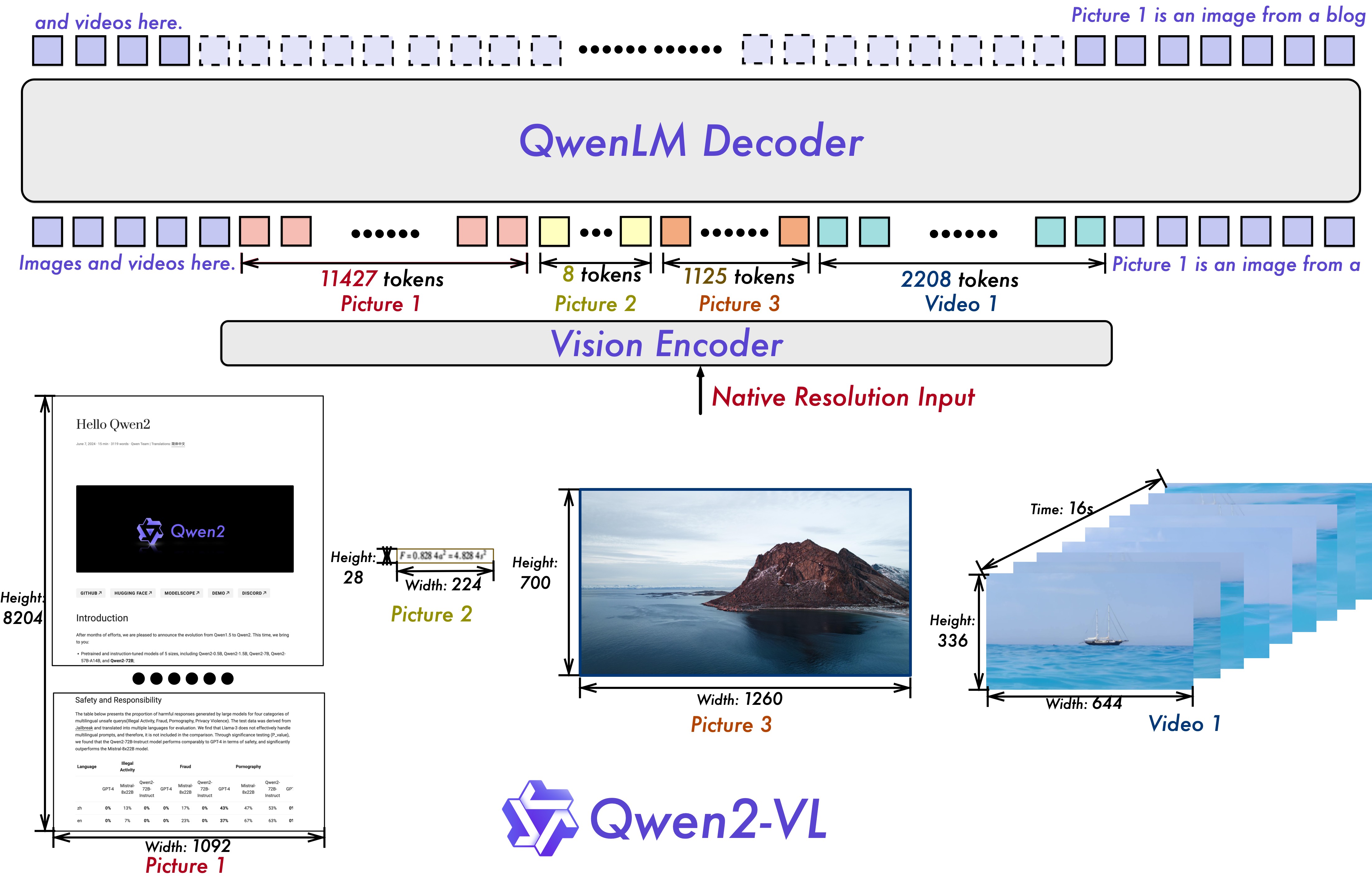
- A key architectural improvement in Qwen2-VL is the implementation of Naive Dynamic Resolution support. Unlike its predecessor, Qwen2-VL can handle arbitrary image resolutions, mapping them into a dynamic number of visual tokens, thereby ensuring consistency between the model input and the inherent information in images. This approach more closely mimics human visual perception, allowing the model to process images of any clarity or size.
- Another key architectural enhancement is the innovation of Multimodal Rotary Position Embedding (M-ROPE). By deconstructing the original rotary embedding into three parts representing temporal and spatial (height and width) information,M-ROPE enables LLM to concurrently capture and integrate 1D textual, 2D visual, and 3D video positional information.

Developing with Qwen2-VL#
To use the largest Qwen2-VL model, Qwen2-VL-72B, you can access it through our official API (sign up the account and obtain the API key through DashScope) temporarily as demonstrated below:}}
The 2B and 7B models of the Qwen2-VL series are open-sourced and accessible on Hugging Face and ModelScope. You can explore the model cards for detailed usage instructions, features, and performance metrics. Below we provide an example of the simplest usage with HF Transformers.
Make sure you install transformers from source by pip install git+https://github.com/huggingface/transformers as codes for Qwen2-VL were just merged into the main branch. If you didn't install it from source, you may encounter the following error:}}
We offer a toolkit to help you handle various types of visual input more conveniently. It supports inputs including base64, URLs, and interleaved images and videos. You can install it using the following command:}}
Here is a code snippet for demonstration. Specifically, we recommend using flash attention 2 if possible for the sake of acceleration and memory saving. }}
To facilitate seamless integration and use of our latest models, we support a range of tools and frameworks in the open-source ecosystem, including quantization (AutoGPTQ, AutoAWQ), deployment (vLLM), finetuning (Llama-Factory), etc.
License#
Both the open-source Qwen2-VL-2B and Qwen2-VL-7B are under Apache 2.0.
What's Next#
We look forward to your feedback and the innovative applications you will build with Qwen2-VL. In the near future, we are going to build stronger vision language models upon our next-version language models and endeavor to integrate more modalities towards an omni model!
原文来自 千问 Qwen Team,版权归原作者。
正文采集于 ,内容更新以原文为准。